

Let’s say your website is ranking on page one of Google. Traffic is coming in. Numbers look decent on paper. But conversions? Inquiries? Actual business? Not so much.
This is the gap that most businesses hit after investing in SEO, and it is more common than people realise. The problem is not that SEO does not work. It is that SEO alone is no longer enough.
What you actually need is Search Experience Optimization, or SXO.
What Is Search Experience Optimization (SXO)?
Search Experience Optimization is the practice of combining traditional SEO with user experience (UX) and conversion strategy to ensure that your website doesn’t just attract visitors but gives them a reason to stay, engage, and act.
In simple terms, SEO gets people to your door. SXO makes sure they walk in.
Where SEO focuses on rankings, keywords, and backlinks, SXO zooms out and asks a bigger question – what actually happens after someone clicks on your website? Are they finding what they need? Is the page easy to navigate? Does it answer their question quickly? Does it make them want to take the next step?
If the answer to any of those is uncertain, you have a search experience problem, not just an SEO problem.
Why SEO Alone Is No Longer Enough?
Search has changed significantly over the last few years. Google is no longer just a directory that matches keywords to pages. It watches how users behave. It tracks whether people stay on your page or immediately revert to search results. It detects scroll depth, engagement, and whether visitors do something after landing on your site.
Here is what the numbers say about the current state of search:
- Over 60% of searches now end without a single click – users get answers directly from AI summaries or search features
- Google’s algorithm increasingly uses behavioural signals – dwell time, bounce rate, engagement, as ranking inputs
- Mobile users, who make up over 63% of all Google searches, are far more likely to leave a page that loads slowly or feels cluttered
What this means for businesses is straightforward. You can do everything “right” with SEO, publish content, build backlinks, optimise meta tags, and still lose customers to a competitor with a better on-page experience.
What SXO Actually Looks Like in Practice?
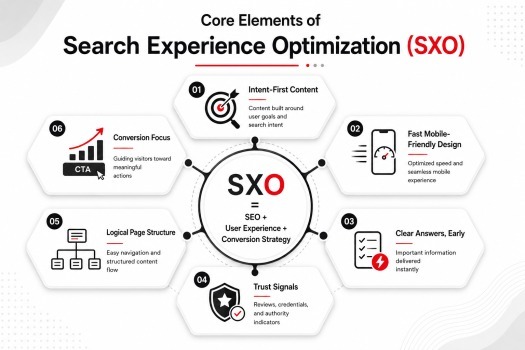
SXO is not a replacement for SEO. Think of it as SEO’s natural upgrade. It covers everything traditional SEO does, and then builds on top of it.
Here is what SXO brings to the table:
- Intent-first content – Pages written around what users are actually trying to achieve, not just keywords they typed
- Fast, mobile-friendly design – Because a slow site is a lost customer, regardless of how well it ranks
- Clear answers, early – Placing the most important information near the top so users (and AI systems) immediately find what they came for
- Trust signals – Reviews, credentials, case studies, and author information that tell visitors your business is credible
- Logical page structure – Easy navigation, clear headings, and calls to action that guide users naturally toward the next step
- Conversion focus – Measuring not just traffic, but what that traffic actually does once it arrives
Are you enjoying reading this blog post?
If you’re interested in having our team handle your marketing needs, please click here
SXO and AI Search: Why It Matters Right Now?
One more reason SXO has become essential is the rise of AI-powered search. Google’s AI Overviews, ChatGPT, Perplexity, and similar tools are changing how people discover businesses online.
These systems do not just look at whether your keywords match a query. They evaluate whether your content is genuinely useful, clearly structured, and trustworthy enough to recommend. In other words, they reward exactly what SXO is built to deliver.
Businesses that optimise for the search experience, clear answers, structured content, and strong trust signals are the ones showing up in AI-generated results. Those who focus purely on traditional SEO metrics are increasingly getting left out.
Q&A: Common Questions About SXO
Is SXO replacing SEO?
No. SXO builds on SEO, not replaces it. Think of SEO as the engine and SXO as the full vehicle. You need both.
How long does it take to see results from SXO?
Some improvements, like page speed and structure, can show impact quickly. Others, like improved rankings from better engagement signals, typically build over two to three months.
Does SXO matter for small businesses?
Absolutely. In fact, small businesses often benefit most from SXO because it helps them compete against larger players by delivering a better, more focused experience for their specific audience.
What is the difference between SXO and CRO?
Conversion Rate Optimization (CRO) focuses specifically on improving conversions. SXO is broader; it encompasses the entire journey from search to action, including how users find you and what they experience along the way.
In Conclusion
Ranking is the starting line, not the finish line. A business that understands this stops chasing traffic for its own sake and starts building a search presence that actually converts.
That is the shift from SEO to SXO, and it is one of the most important strategic moves a business can make right now.
Ready to Move Beyond Just Rankings?
If you would like to understand where your current search experience stands and what can be improved, get in touch with the Magnarevo team, and let’s have a straightforward conversation about what’s working and what’s not.
About Author

Raised in India, I earned a Masters in Marketing from Swinburne University. Initially in Sales, I pivoted to Digital Media in 2013. Now, as the driving force behind Magnarevo, I leverage my expertise to guide branding and marketing, leading our sales and marketing teams. Keen on collaborations, I guide businesses to elevate their digital presence. Reach out at karan@magnarevo.com. Specialities: Branding, marketing strategy, digital media, ad management, website development, and analytics.