Here is something strange that many businesses are experiencing right now.
Their Google rankings have not dropped. Their keywords are still on page one. But their website traffic is quietly declining month after month, and nobody can quite explain why.
Search traffic is genuinely getting harder to earn in 2026, and the reasons have very little to do with your SEO doing anything wrong.
The Rankings Are Fine. So, Why Is Traffic Falling?
For years, the logic of SEO was simple. Rank higher, get more traffic. The higher the position, the more clicks you earn.
That logic is breaking down.
The issue is not that Google has penalised your site or that a competitor has suddenly overtaken you. The issue is that the search results page itself has fundamentally changed, and a growing share of users are getting their answers without ever clicking through to any website.
This is called zero-click search, and it is now the default behaviour on Google.
The problem is not your position on Google. It is that even a page-one ranking no longer guarantees the click it once did. Search behaviour has shifted, and the gap between being visible and actually getting visited has never been wider.
That means for 8 out of 10 searches where an AI Overview appears, no one clicks anywhere.
What Is Driving This Shift?
Two things are happening simultaneously, and both are compounding each other.
- First: Google is answering questions itself. AI Overviews now appear for roughly 13% of all queries, but that 13% covers the highest-volume informational searches. These are the “what is”, “how to”, and “best way to” type queries that used to be reliable traffic drivers for most business blogs and content pages. When an AI Overview appears for those queries, organic click-through rates drop by up to 61%.
- Second: AI search platforms are growing fast. ChatGPT now processes over one billion searches per week. Perplexity, Gemini, and similar tools are growing alongside it. These platforms read your content, extract the relevant answer, and deliver it directly to the user, without ever sending them to your website. The traffic goes nowhere you can track in Google Analytics.
The result is a search environment where your content may be informing thousands of people every day, while your session numbers tell a completely different story.
The Metrics That Are Lying to You
This is worth pausing on because it changes how you should be reading your own data.
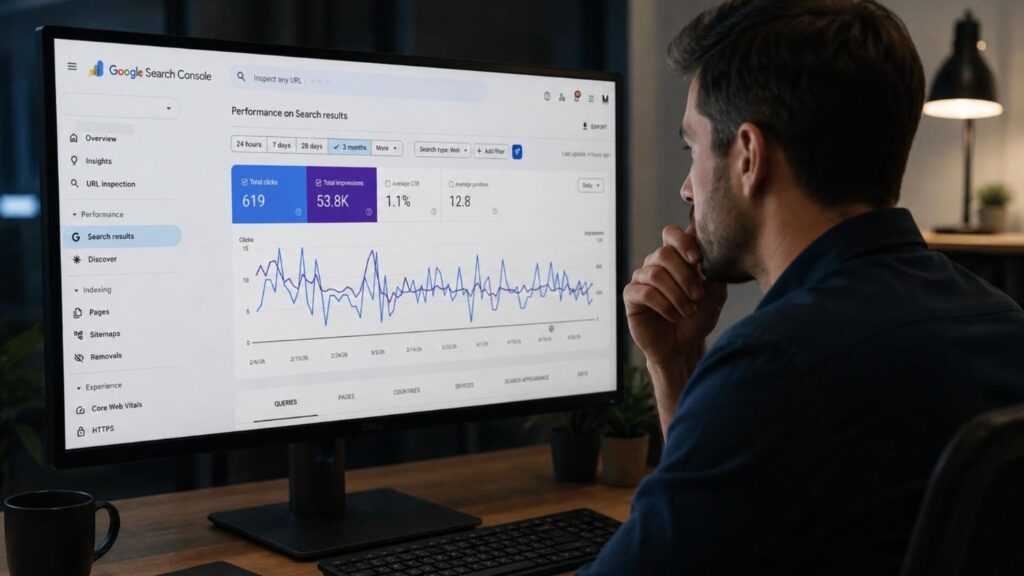
If your Google Search Console shows impressions holding steady or even growing, but clicks are falling, you are not looking at a performance problem. You are looking at a structural shift in how search works.
Impressions are going up because Google now shows AI Overviews alongside your organic listing, and it counts both separately. But when users get the answer from the AI summary, they never click through. Your impression count looks healthy. Your traffic does not.
Are you enjoying reading this blog post?
If you’re interested in having our team handle your marketing needs, please click here
What does this actually mean for Your Business?
Before this turns into an all-out panic, here is an important nuance.
Not all traffic is affected equally. Zero-click behaviour is most pronounced on informational queries, the type of content that educates, explains, or answers general questions. Transactional and navigational searches, where someone is actively looking to buy something or reach a specific business, still drive clicks. People researching “best SEO services in Mumbai” or “digital marketing agency near me” still need to visit a website to make a decision.
What is changing is where the value of your content sits. In 2026, appearing in an AI-generated answer is a form of visibility, even when it produces no direct click. Brands that are consistently cited in AI Overviews earn more organic clicks than those that are not, because such citations build recognition and trust even at the search level.
Then vs Now: How Search Has Changed?
| What Used to Work | What Works Now |
|---|---|
|
Ranking #1 guaranteed traffic
|
Ranking #1 still matters, but AI Overviews absorb clicks above it
|
|
More content = more traffic |
Authoritative, well-structured content = AI citation + trust |
|
Track success through sessions |
Track success through visibility, citations, and conversions |
|
Target keywords |
Target intent, questions, and topical authority |
|
Backlinks drove rankings |
Backlinks + E-E-A-T signals + structured data drive AI inclusion |
What Businesses Should Focus on Now?
The response to all of this is not to abandon SEO. It is to evolve how you think about it.
A few shifts that matter right now:
- Write for intent, not just keywords.
- Structure your pages clearly.
- Build topical authority.
- Focus on high-intent traffic.
- Track the right things.
Where Does This Leave You?
Search traffic being harder to earn is not a sign that your business is doing something wrong. It is a sign that the rules have changed, and the businesses that adapt earliest will hold a meaningful advantage over those that wait.
The goal is no longer just to rank. It is to be the source that search engines and AI systems trust enough to cite, recommend, and send high-intent visitors to.
If your traffic numbers are not telling the full story, or if you are not sure how your business fits into this new search landscape, it is worth having a proper look at your current strategy.
Talk to the Magnarevo team, and let’s figure out what your search presence actually needs right now.
About Author

Raised in India, I earned a Masters in Marketing from Swinburne University. Initially in Sales, I pivoted to Digital Media in 2013. Now, as the driving force behind Magnarevo, I leverage my expertise to guide branding and marketing, leading our sales and marketing teams. Keen on collaborations, I guide businesses to elevate their digital presence. Reach out at karan@magnarevo.com. Specialities: Branding, marketing strategy, digital media, ad management, website development, and analytics.