The debate between brand mentions and backlinks has been simmering in SEO circles for years, but the question itself might be framed incorrectly. It’s not about which one matters more; it’s about understanding how search engines evolved to interpret signals of authority and trust, and why both elements play complementary roles.
What worked when backlinks were the primary currency of SEO doesn’t work the same way now that search algorithms have matured into something more sophisticated.
How are Search Engines Evaluating Authority Differently Now?
Early algorithms were relatively simple; they counted backlinks like votes. More links meant more credibility. This worked until people started gaming it.
Search engines responded by evaluating not just quantity but relevance, anchor text, surrounding content, and whether link patterns looked natural. Over time, algorithms incorporated signals that didn’t depend on links so much.
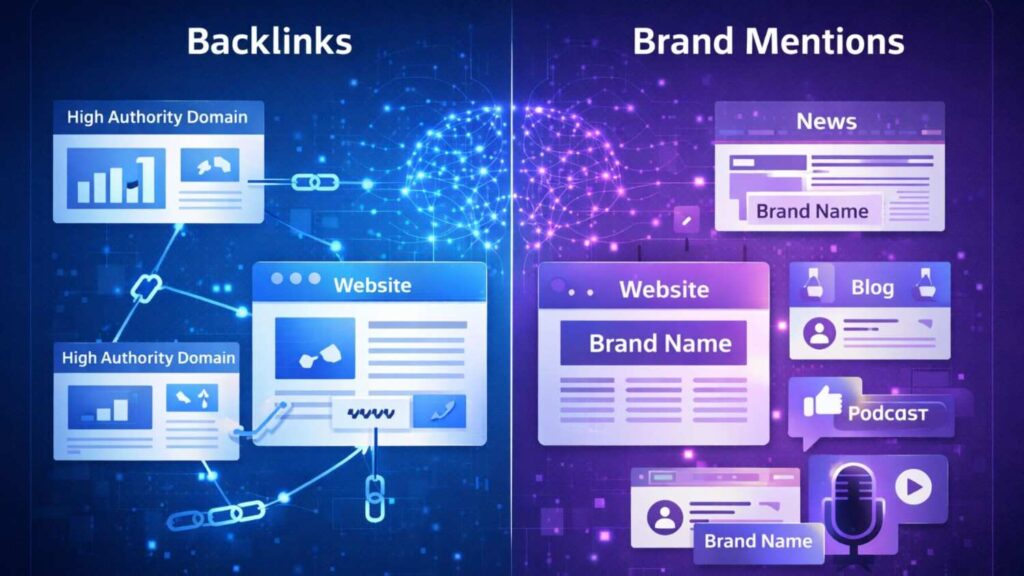
This is where brand mentions enter. A brand mention is when your company name appears on another website, in articles, on social media, or any public digital space, with or without a clickable link. For years, these mentions were considered inconsequential from an SEO perspective. No link, no value.
That assumption eroded as search engines developed the ability to understand entities such as specific brands, people, places, and concepts, independent of how they’re linked. When search platforms see your brand mentioned repeatedly across credible sources, they build a profile of your brand’s authority and relevance, even without direct links.
Why Backlinks Still Carry Weight?
Backlinks haven’t lost their value. They remain one of the strongest signals search engines use to evaluate authority. A quality backlink from a reputable, relevant source tells algorithms that someone found your content valuable enough to reference directly. That endorsement carries meaning.
The keyword is quality. A thousand low-quality links from spammy directories might have worked in 2010. Today, they’re more likely to hurt than help. What matters now is earning links from sources that have authority in your industry, where the link makes sense contextually, and provides genuine value to readers.
What Brand Mentions Actually Signal?
Brand mentions work differently. When your company name appears in industry publications, news articles, podcasts, social discussions, or forums, even without a link it contributes to your digital footprint. Search engines track these mentions to understand your brand’s visibility, reputation, and relevance within specific topics or industries.
Think about how authority works in the real world. If you hear a brand mentioned repeatedly by people you trust, you form an opinion based on context. Are they mentioned positively? Are they associated with specific expertise? Do they come up in conversations about particular problems?
Search engines process brand mentions similarly. They evaluate sentiment, context, the source authority, and the frequency with which your brand appears across platforms. This helps them build entity understanding, a holistic view of your brand’s place within the broader web ecosystem.
Are you enjoying reading this blog post?
If you’re interested in having our team handle your marketing needs, please click here
The Practical Differences Between the Two
Understanding how these signals differ helps clarify when to prioritize each one. Here are the key distinctions:
Backlinks provide:
- Direct authority transfer through link equity flowing from one domain to another
- Immediate ranking impact for specific pages and queries
- Referral traffic that arrives with context and intent
- Measurable SEO value that tools can track and quantify
Brand mentions contribute:
- Ambient authority that builds your overall entity profile
- Long-term credibility that compounds across your entire domain
- Brand recognition that strengthens over time through repeated exposure
- Trust signals that search engines use to validate your expertise
Both matter, but they work on different timescales and through different mechanisms. Backlinks show more immediate impact on specific pages. Brand mentions build long-term brand authority that lifts your entire domain’s credibility.
What Modern SEO Strategy Actually Requires?
The most effective approach doesn’t treat these as competing priorities. Building real authority requires both direct endorsements through backlinks and broader brand recognition through mentions.
The leading SEO companies focused on sustainable growth will pursue strategies that generate both. This includes creating resources other sites want to link to, contributing expert commentary that gets quoted, building relationships with journalists, and maintaining active participation in relevant communities.
When to prioritize backlinks:
- Launching a new website or domain that needs foundational authority
- Targeting competitive keywords where direct link equity makes a measurable difference
- Building authority for specific pages or content pieces
- Establishing initial credibility in a new market or industry
When to emphasize brand mentions:
- Building long-term entity recognition for an established brand
- Expanding into thought leadership and industry influence
- Creating awareness in spaces where direct links are harder to earn
- Strengthening overall domain authority across multiple topic areas
Brand mentions can also convert into backlinks over time. When your brand becomes well-known within a niche, people start linking to you. This creates a cycle where mentions lead to links, which reinforce authority, which generates more mentions.
The Reality of How Algorithms Have Matured
Search algorithms today process signals in ways that were impossible ten years ago. They understand context, interpret sentiment, recognize entities across naming variations, and connect information that isn’t directly linked. This sophistication means they’re less dependent on any single ranking factor.
What this means practically: over-optimizing for either backlinks or brand mentions while ignoring other fundamentals like content quality, user experience, topical authority, and technical SEO, creates an imbalanced strategy. Search engines evaluate sites holistically, looking for consistency across multiple trust signals.
This perspective shift guides thoughtful search strategy at Magnarevo, where the focus remains on building sustainable authority through multiple channels rather than chasing individual ranking factors in isolation.
About Author

Raised in India, I earned a Masters in Marketing from Swinburne University. Initially in Sales, I pivoted to Digital Media in 2013. Now, as the driving force behind Magnarevo, I leverage my expertise to guide branding and marketing, leading our sales and marketing teams. Keen on collaborations, I guide businesses to elevate their digital presence. Reach out at karan@magnarevo.com. Specialities: Branding, marketing strategy, digital media, ad management, website development, and analytics.