Search isn’t what it used to be. That much is obvious to anyone who’s been paying attention over the past few years. What’s less obvious is how fundamental the shift has been, not just in how Google ranks pages, but in how people search, what they expect to find, and how trust gets built in a crowded digital space.
By 2026, the brands winning at organic search aren’t the ones with the biggest budgets or the most aggressive link-building campaigns. They’re the ones who figured out that SEO stopped being a technical trick years ago and became more about brand credibility. The rankings are just evidence of that credibility, not the end goal itself.
Whether you’re running growth in-house or partnering with a professional SEO company in India, the question isn’t “how do we rank higher” anymore. It’s “how do we become the kind of source people trust enough to rank us?” That’s a different challenge entirely.
How Search Behavior Changed Without Most People Noticing?
A few years ago, someone looking for information would type a keyword into Google and click through results until they found an answer. Today, that same person might ask an AI chatbot, check social media, watch a YouTube video, or search on a niche platform, all before they consider typing something into a traditional search engine.
The fracturing of search behavior means that organic growth in 2026 isn’t just about showing up on page one of Google. It’s about being findable across the ways people actually look for answers now. And those ways are more conversational, more fragmented, and more intent-driven than ever.
Intent has always mattered in SEO, but now it’s the foundation. People don’t just search for “SEO services“; they search for solutions to specific problems they’re facing. A business owner might search “why isn’t my website getting customers” instead of “conversion rate optimization.” Understanding that gap and creating content that bridges it is what separates content that ranks from content that drives results.
The Real Shift in How Content Gets Evaluated
There’s still a belief that if you write long, keyword-rich content and build enough backlinks, you’ll rank. That worked once. It doesn’t anymore.
Search engines have gotten better at measuring whether content actually helped someone. They look at what happens after the click, how long someone stays, whether they engage, and critically, whether they come back to search for the same thing again. If your page answered their question, they’re done. If it didn’t, they refine their search, and you’ve just signaled that your content missed the mark.
Authority Isn't Something You Claim, It's Something You Demonstrate
One of the biggest mistakes brands make is confusing visibility with authority. You can pay for visibility. You can’t pay for authority.
Authority in search comes from showing up consistently with useful insights over time. It comes from publishing content that reflects real expertise, not just surface-level research. And it comes from alignment between what you say publicly and what you actually deliver.
Are you enjoying reading this blog post?
If you’re interested in having our team handle your marketing needs, please click here
What AI Actually Changed About SEO?
AI has reshaped parts of SEO significantly, but not in the way most headlines suggest. It didn’t eliminate the need for human expertise. If anything, it made expertise more valuable.
AI is excellent for research, analysis, and first drafts. It can process enormous amounts of data and generate content frameworks faster than any human could. But AI struggles with the things that actually differentiate content: understanding nuance, applying judgment from experience, and knowing which details matter to your specific audience.
The brands using AI effectively in 2026 treat it as a tool for efficiency, not a replacement for strategy. They use it to speed up research, then apply human expertise to turn those frameworks into something valuable and differentiated.
The Trends That Will Actually Shape Growth in 2026
Most trends don’t matter. A handful of shifts, though, are genuinely reshaping organic growth.
- Search experience matters as much as search optimization
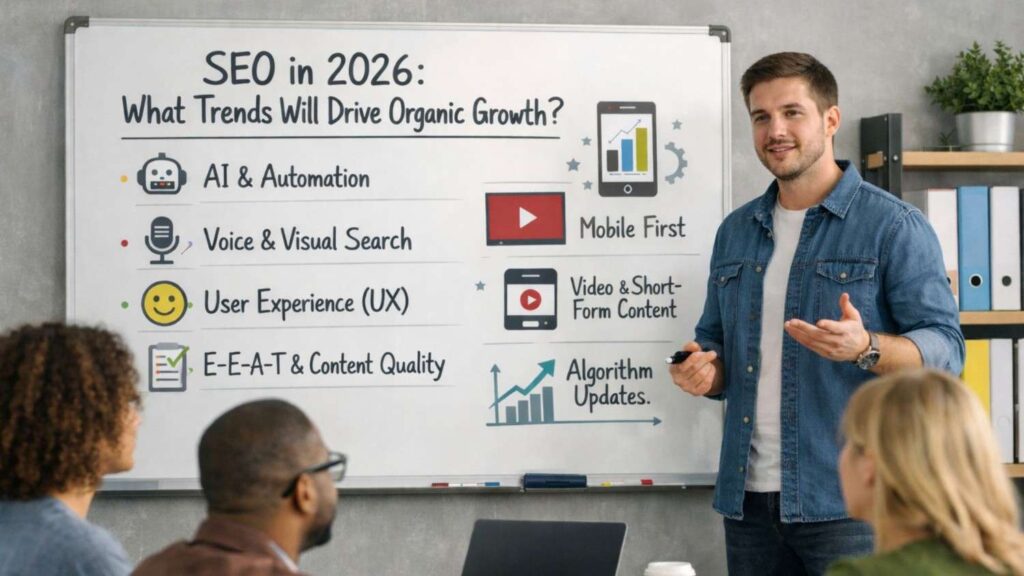
How easy your content is to read, navigate, and understand directly impacts whether it ranks and performs. User experience is now part of the ranking equation in ways it wasn’t a few years ago.
- Topical depth beats keyword breadth
Brands that go deep on specific subjects consistently outrank those trying to cover everything. Search engines interpret depth as expertise.
- Brand search volume influences non-brand rankings
When people search for your brand by name, it signals trust. Search engines use that signal to boost your authority across all queries, not just branded ones.
Multi-platform visibility compounds
Organic growth isn’t just about Google. It’s about being discoverable across AI search, social platforms, video content, and wherever else your audience looks for answers.
What Drags Growth Down Even When Everything Else Is Right?
- Publishing content purely to hit keyword targets
When you create pages without considering what users actually need, they might rank briefly but won’t hold position. You get traffic that doesn’t convert.
- Over-optimizing until content becomes awkward
When every paragraph feels written to please an algorithm rather than help a reader, real people disengage. Those engagement metrics influence rankings more than keyword density ever did.
- Treating SEO as a campaign instead of a system
Organic growth requires sustained effort over months and years. Brands that approach it in sprints inevitably plateau.
Copying competitor strategies without understanding context
What works for an established brand with high domain authority might fail for a newer player.
Where This Is All Headed?
SEO in 2026 is quieter and more strategic than it used to be. It rewards patience over tactics, clarity over volume, and expertise over keyword optimization. The brands pulling ahead stopped trying to game the system and started focusing on becoming genuinely useful resources.
Search platforms are moving closer to human judgment, not further from it. They’re getting better at identifying quality, originality, and trustworthiness. Strategies built on manipulation continue losing ground while strategies built on serving users continue gaining traction.
Organic growth now reflects how well you understand your audience, how clearly you communicate your expertise, and how consistently you show up with something worth finding. Those fundamentals matter more than any algorithm update, and they remain the core of how we approach search strategy at Magnarevo
About Author

Raised in India, I earned a Masters in Marketing from Swinburne University. Initially in Sales, I pivoted to Digital Media in 2013. Now, as the driving force behind Magnarevo, I leverage my expertise to guide branding and marketing, leading our sales and marketing teams. Keen on collaborations, I guide businesses to elevate their digital presence. Reach out at karan@magnarevo.com. Specialities: Branding, marketing strategy, digital media, ad management, website development, and analytics.